
When it comes to voice acting, technique matters – but technique alone isn’t what makes a performance unforgettable. What audiences connect to most is honesty.
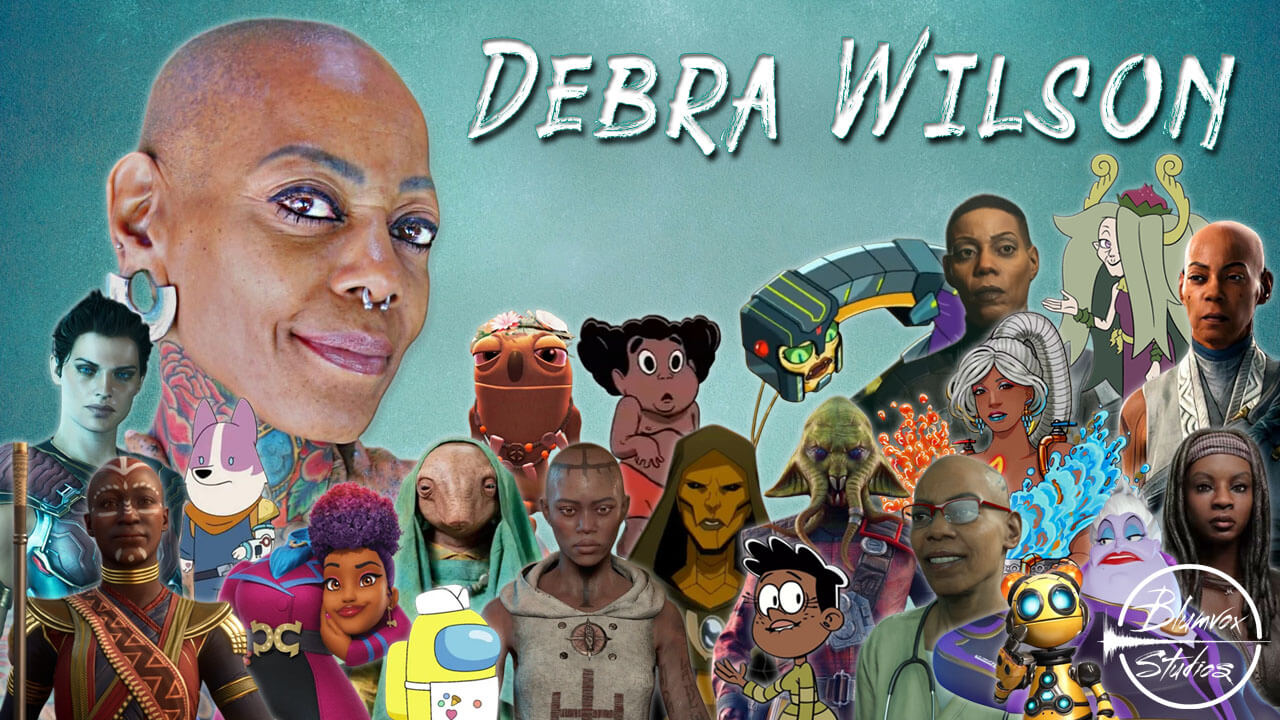
In a deeply inspiring class here at Blumvox Studios, Debra Wilson explored what truly gives a performance life: storytelling, emotional honesty, physical embodiment, and the courage to bring your full self into the work.
Debra spoke passionately about it all, and in this article we’ll share some of her powerful insights, and why they matter for anyone wanting to build a sustainable, creative career while remaining true to who they are.
Voice Acting Is Storytelling
One of the strongest themes throughout Debra’s class was the idea that voice actors are storytellers first.
Not performers.
Not impressionists.
Not “voice people.”
Storytellers.
Stories are how people communicate emotion, survival, culture, pain, celebration, and identity. Debra reminded our students that humans have always been storytellers – long before microphones, animation, or video games existed.
While newer actors often approach auditions by focusing on the sound of the voice – obsessing over tone, placement, pitch, or whether the character sounds “cool enough”, Debra argues that audiences don’t actually connect to voices.
They connect to feeling.
As she put it, people don’t want to hear your voice nearly as much as they want to feel the story.
A technically perfect read without emotional truth can feel empty, while a flawed or unconventional voice can become unforgettable when it carries genuine emotional weight.
Debra illustrated this beautifully through a simple line reading example:
“Wow, it’s really cold out. Maybe we should go inside.”
On paper it’s an ordinary sentence. But when an actor physically embodies the cold – shivering hands, shortened breath, tight chest – the audience immediately begins filling in the rest of the world themselves.
Listeners imagine snow, wind, temperature, environment, clothing, and vulnerability.
It’s those feelings that help an audience become part of the story. One that they’ll remember.
The Actors Job
Debra emphasized that the actor’s job is not simply to recite words, but to breathe life into what’s written. The script provides the structure, but it’s the actor that supplies the emotional experience.
This is especially important in voiceover because you can’t rely on facial expressions, costumes or cinematography. The emotional reality needs to exist inside the performance itself.
Debra encourages actors to focus on the “in-between” spaces of the script – the environment, the relationships, the temperature of the room, who the character is speaking to, what happened moments before the line began. These are the invisible details that create emotional depth.
Anyone can read the words, but not everyone can tell the story, and that’s ultimately what separates successful, working actors from those we might quickly forget.
Your Greatest Asset Is Your Authenticity
Perhaps the most transformative idea Debra shared was this:
Your “X factor” is not your vocal ability. It’s your authenticity.
That message directly challenges one of the biggest fears many performers carry – the fear that they are not unique enough.
In voice acting, as in life, comparison can be brutal. Actors are constantly met with incredible performances online and in games and movies. It becomes easy to believe that success belongs only to people with extraordinary voices or rare vocal tricks.
Debra dismantles that thinking completely.
She argues that newer actors often place too much value on the mechanics of the voice while neglecting the emotional truth underneath it.
The problem with relying solely on vocal technique is that technique alone becomes replaceable.
Another actor can imitate a similar sound.
Another actor can perform a similar archetype.
Another actor can hit the same vocal range.
But nobody can replicate your lived experience.
Nobody else has survived your exact hardships, relationships, failures, grief, joy, fear, or growth.
And those experiences are your fuel for storytelling.
“When you are telling somebody else’s story, the conjoining between your emotions and your opinions and your feelings allows this being who’s flat and one dimensional to be able to breathe life. Even if it is an inanimate object, the moment that it speaks it is human in some form, and since you have lived your ups and your downs, your lulls, your sorrows, your sadness, your sufferings, your celebrations, you are being possessed by, and channeling that. That is why you as a storyteller is so important, and being able to give that away is a powerful place. It will precede you and your reputation before you even walk in a room without with your voice, because people will know you are there to tell their story.”
Acting is a symbiotic relationship between the written material and the actor’s own emotional reality.
That means your pain matters.
Your victories matter.
Your awkwardness, heartbreak, loneliness, hope, resilience, and personal history all matter!
Self-Worth
Debra also helped students work through their feelings of rejection, and spoke on the danger of allowing external validation to determine their self-worth. She noted that many actors become emotionally destroyed by auditions because they unconsciously expect jobs to validate them as human beings.
The entertainment industry cannot provide lasting self-worth.
Booking that gig can’t permanently fix insecurity.
A callback won’t heal self-rejection. And no role can replace genuine self-acceptance.
Debra repeatedly reminded students that they must learn to “say yes” to themselves before waiting for the industry to do it.
When it comes to auditions that mindset shift is powerful because it changes the emotional relationship actors have with the process. Instead of seeking approval, the actor begins approaching auditions as opportunities to share truth.
Instead of “Please choose me,” the mindset becomes:
“This is what I bring to the table authentically.”
That confidence creates freedom.
Freedom removes desperation.
And freedom often produces better performances!
Debra summarized this philosophy perfectly when discussing the word “impossible.” She encouraged actors to separate the phrase into “I’m possible.”
“When you take the word impossible and you separate the I am from the possible and put an apostrophe between those first two letters, impossible turns to I’m possible. Otherwise, you wouldn’t be here.
You have to own self-love. The mindset is ‘I am worthy and I am enough.’
You work for it. You fight for it. You accept it, you allow it.”
It’s simple but deeply meaningful, because it requires believing that who you already are has value.
Not someday.
Not after more credits or better representation.
Now.
The Body Tells the Truth Before the Voice Ever Does
One of the most fascinating parts of the class was centered on physicality.
Many newer voice actors assume voiceover exists entirely from the neck up. They focus almost exclusively on vocal sound while remaining physically still behind the microphone.
Debra approaches performance very differently.
For her, the body informs the voice.
Physical movement creates emotional reality.
She described how body language naturally influences vocal tone, breath, emotional rhythm, and character energy. Even subtle posture changes can completely transform a read.
That’s why she always physically embodies her characters – even in animation and creature work.
When performing Star Wars: The Rise of Skywalker characters, fantasy creatures, or iconic villains like Ursula, she allows her body to move instinctively with the character’s emotional state.
Sometimes she rises onto her toes.
Sometimes her shoulders collapse inward.
Sometimes her breathing changes before the voice even arrives.
And often, the voice itself emerges naturally from the physical experience rather than from intellectual planning.
“The body doesn’t lie.”
She even connected this concept to real-world psychology and body language analysis – noting how physical tension, eye movement, posture, and breath reveal emotional truth long before words do.
For actors, this can be incredibly freeing. Instead of forcing a performance mentally, the actor can physically enter the world of the character and allow the voice to follow organically.
Debra described this vividly while discussing creature vocal development for video games. Rather than beginning with a preconceived “monster voice,” she immersed herself in imagined environments – darkness, humidity, altitude, breath patterns, animal movement, environmental conditions.
From there, the voice evolved naturally. The performance became rooted in an environment and physical sensation rather than random vocal experimentation.
This approach also explains why Debra’s performances feel so emotionally alive.
Her voice is not disconnected from her body, but generated through her body.
That distinction matters tremendously for actors trying to create believable performances in animation, games, or creature work.
Audiences may not consciously see the physicality behind the microphone…
…but they absolutely hear it.
Why Debra Wilson’s Philosophy Matters Right Now
What makes Debra’s perspective so impactful is that it cuts through many of the unhealthy myths surrounding creative careers.
The entertainment industry often teaches performers to chase:
- approval
- status
- representation
- followers
- validation
- technical perfection
Debra Wilson redirects attention toward something much deeper:
- emotional honesty
- storytelling
- embodiment
- self-worth
- authenticity
- service
- human connection
That philosophy creates stronger performances, and healthier artists.
In an industry filled with rejection, comparison, burnout and insecurity, that mindset may be more valuable than any technical skill.
For Debra Wilson storytelling is an act of service. Actors are helping audiences feel less alone.
That responsibility requires vulnerability, but it also creates meaning.
Because ultimately, the performances people remember most are rarely the ones with the “best voice.”
They’re the ones that made people feel understood.
The insights in this article were taken from Class 112 at Blumvox Studios – “From Impossible to I’m Possible” with Debra Wilson. Here’s a clip from the class to give you a taste of just how powerful the conversation was: https://youtu.be/4nygjMcv2Ks
If you’re interested in checking out the full class, or any of our other classes at Blumvox, click here to become a student.